Friday, June 21, 2013

Snake Day

This morning Sue noticed that the pair of Phoebes nesting just ouside our back door where very agitated. When I came out to see what was going on I was able to snap these two photos of a contented black snake who had obviously found a way to make a meal of someyoung hatchlings.

Later in the morning I saw this pretty little garden snake twined around the protective grate of our new heat pump.

Tuesday, June 11, 2013

Fergus Survives Cytauxzoonosis -- aka Bobcat Fever


Cytauxzoonosis or Bobcat Fever has been aptly described as Ebola for domestic cats. The disease is endemic and nonfatal in bobcats, but is far more deadly among smaller cats. It was first observed in Missouri in 1976 and killed over 90% of infected felines. It has since spread from Florida to North Dakota and as far east as Pennsylvania.

Lone Star Tick

The disease is caused by a protozoan parasite named Cytauxzoon and is spread primarily by the lone star tick. During a certain stage of development, these protozoa gum up the smaller vessels in the cat's circulatory system, eventually causing multiple organ failures and an agonizing death. The initial symptoms are lethargy and (at least in our cat Fergus) the vomiting of clear bile at intervals of several hours.

I first noticed Fergus vomiting sometime during the night of Friday, May 24. Since Fergus often goes out to eat grass and then comes inside before throwing up, I didn't make much of it--except for being mildly surprised by the absence of grass in the bile. By Sunday morning he had vomited several more times and was dozing continually. I isolated him with a clean litter box and set out measured amounts of food and water to see if he was seriously ill. He didn't eat or drink, and when he vomited a few more tablespoons of clear bile at 6:30 pm without even having the energy to get off the bed, we put in an emergency call to our veterinarian, Dr. Christina White of the Animal Health Center in Mountain Home, Arkansas.

By 7:30 pm she was treating him. He had a fever of over 107 degrees (about 100 is normal in cats), and she immediately suspected Bobcat Fever. She put him on an intravenous drip to begin hydrating him in an effort to bring down the fever. She also took a blood sample and examined a smear under a microscope in order to confirm her diagnosis.
Note  the shaved patch where the IV was attached
Only three years ago Fergus would have been doomed at this point. Among animals whose temperature exceeded 106 degrees, the survival rate was minuscule, and death was expected within one to three days. The most humane treatment would have been euthanasia.

Fortunately, in 2010 a pair of veterinarians from the University of Missouri published a paper about a promising new treatment of Cytauxzoonosis, involving hospitalization, hydration, and aggressive treatment with the antimalarial drug Atovaquone and the antibiotic Azithromycin. They reported a survival rate of approximately 60%.

Fergus remained hospitalized until Wednesday, and then we brought him home with our precious vials of Atovaquone and Azithromycin to continue his treatments for another week--1.7 cc of Atovaquone every 8 hours and 1 cc of Azithromycin daily, administered by prying his mouth open and squirting the doses down his throat with a syringe.

Although he seemed entirely cured as soon as he was released from the pet hospital, we were aware of the need to be sure that no more protozoa were developing in his blood system and that he did not develop any secondary infections as a result of the circulatory stress and potential  organic damage. Only now can we begin to breath easy.

Fergus has gone from being a pampered pet who treasured the beauty of an Arkansas spring to an even more appreciated pet who is already seeking out more cerebral indoor enjoyments like card games and music.


Further Information:
http://www.merckmanuals.com/vet/circulatory_system/blood_parasites/cytauxzoonosis.html

http://www.sciencedaily.com/releases/2012/04/120418162258.htm

http://www.examiner.com/article/most-cats-with-bobcat-fever-saved-by-new-treatment

http://www.catster.com/the-scoop/house-cats-falling-prey-to-bobcat-fever

Thursday, February 21, 2013

Cell Phone Cinema


In past blogs I have tried to highlight what can be done with the relatively primitive digital camera on my cell phone. Recently, I have upgraded to a much more advanced cell phone, a Samsung s390g. It is still a Tracfone and its total cost was less than $35 so it is not very advanced by contemporary standards. Still, one can use it to place and receive calls; it has a very fine mp3 player along with a standard assortment of calendars, calculators, memo pads, and alarms; it has free web browsing via wifi; and most importantly from the point of view of this blog entry, its two megapixel camera is a big step up from the one on my previous phone. Sue says that it isn’t really a smartphone, but rather one with above average intelligence. I am now using it almost exclusively to record my progress in construction. The video here is my first use of the movie camera on the new phone:

Speaking of construction, I have just passed a number of milestones. The windows are all in so that the west wing is now completely enclosed. The wiring is finished. The mini-split heat pump is scheduled for delivery today. And crucially the ping pong table has been moved from the garage to it new home in the west wing.

Bedroom wall--Note the wiring

Two layers of 1/2" foam provide insulation

The fixed-pane windows

The area for the mini-kitchen with its window

The great room

Wednesday, January 23, 2013

Almost Enclosed

After four more weeks of work--made intermittent by Christmas celebrations and the inevitable winter weather--we have finished the siding and begun work on the interior.


Saturday, December 15, 2012

Three More Work Weeks

Three good weeks of work have resulted in significant progress. Soon after Thanksgiving break I was able to get shingles delivered onto the lower end of the roof. This first required me to power up my chain saw and clear a wide enough route so that the fork lift could make its way back of the addition where the roof is low enough to allow roof-top delivery. Shingling forced me to buy my fifth pneumatic air gun, since renting one for the four-day duration of the actual roofing would be as expensive as buying one. Amazon accommodated with one-day delivery. What an amazing modern world! After the shingles were distributed, the roofing could begin in earnest.
 Terry and Jim glue down the final strip of shingles.
 Framing of the walls is a piecemeal project since the walls don't carry any significant weight. The horizontal 2x4s are nailing strips to which the vertical pine siding will be attached on the outside and the vertical car siding will be attached on the inside. The finished walls of solid wood eventually create a very strong structure.
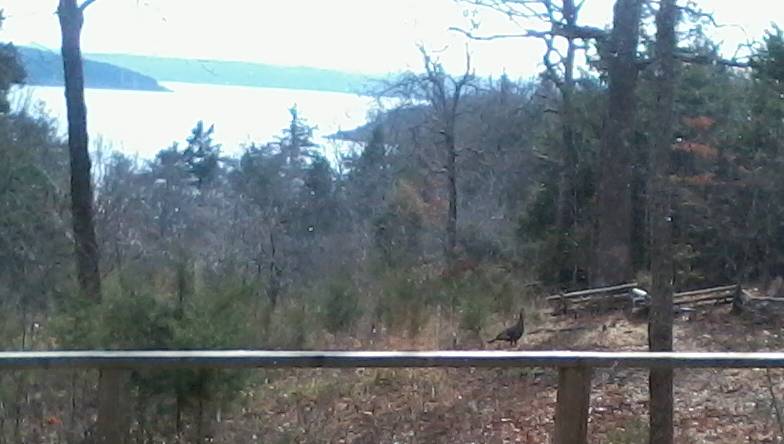
 You can see below that I have cleared a bit more of the downhill brush. Notice the turkey posing for the photo just above the deck railing.
 Morning walks to the water at this time of year can be very foggy, but it is eerily lovely as the fog rises.
 Here we are attaching the very last panel of exterior foam insulation.
 The highly reflective addition is starting to look like a house.
 Here is another view of the structure. We are starting to get of sense of how the finished building will appear.