On Friday Sue and I rode out to Elizabeth -- a town notable only because it is the site of our mailing address and because there is nothing whatsoever in town except the post office and one fellow who makes bird boxes for sale. The birdhouses are set up by the street in a totally untended display with no attached prices that I could see.
Anyway, it is a beautiful ride to Elizabeth and back -- smooth blacktop through the rolling hills of mostly empty cattle farms. At the post office one can turn right and head to the lake two miles away through a pine forest with some good views of Matney Mountain in the extreme distance. The run down to the lake is more than a mile of rolling downhill (and challenging uphill on the way back).
I forgot to take many pictures, but I did grab this one shot of a classic, collapsing Ozark barn.
This blog records various activities that my wife and I enjoy within one day's drive of our cabin on Lake Norfork in the Arkansas Ozarks. Of course, many of these activities take place right on the lake outside our window, so the earliest entry begins with a little factual information (culled from various web sites) about the lake and its history.
Saturday, June 16, 2012
Thursday, June 7, 2012
Venus Transits the Sun
Eight years ago on June 8, 2004, I woke up well before dawn and carted my solar telescope to an open field with a view of the eastern horizon. The Sun would rise at about 6 AM, and when it rose, the first transit of Venus across the Sun in more than one hundred years would be almost over. The third contact (when Venus starts to pass out the disk of the Sun) would begin at 6:06 AM, and the transit would be over by by 6:26 AM.
As it happened, I was not able to observe any portion of the transit. By the time the Sun rose over the treetops on the distant shore of the lake, it was already 6:30 AM. Game over.
Fortunately, transits of Venus occur in pairs separated by enormous gaps in time. I had only to wait a trivial eight years for my second (and last) opportunity to view a transit of Venus. The great event took place this past Tuesday afternoon, starting at 5:06 PM CDT. I planned for the occasion and watched the weather with an uneasy eye. When the day came, the heavens cooperated with a cloudless skies and a mild temperatures. I was able to set up the solar scope half-way down the driveway and watch the most impressive parts of any transit--from the moment when the small black dot of Venus first begins to chew into the bright disk of the Sun all the way through at least half of the entire six-hour event.
My solar telescope is actually the best use of the little 60mm telescope that served to introduce my family to observational astronomy. These "beginner" telescopes are too often scorned by amateur astronomers. It is true that they are advertised as having unrealistic and unusable high magnifications of 300X or more. At those magnifications they provide dim views on very shaky mounts. But if one uses a fairly good 25mm eyepiece (which can be salvaged from an old pair of binoculars), a 60mm scope can be very satisfactory for most low-magnification observing.
![]() |
| My Solar Telescope (with its filters) |
Astronomy magazine. The downside of doing this is that I needed to stop the objective lenses of both the 60mm main tube and the 50mm finder down to a mere 25mm--even smaller that the 37mm of Galileo's first telescope in 1609.
The photos below show the basic setup. The images we were able to see through the scope were much better than the ones I captured by holding a digital camera up to the eyepiece. In fact there wasn't much difference between what I saw and the high-quality photo at the top of this blog. At one point I counted fourteen sunspots.
![]() |
| Jeff observing the transit |
![]() |
| Sue observing the transit |
![]() |
| Venus first digs into the Sun |
![]() |
| Venus fully within the Sun's disk |
Friday, May 4, 2012
Sylamore Creek
Yesterday Sue and I took a little hike North Sylamore Creek Trail in the Ozark National Forest. This is undoubtedly one of the best hiking routes in Arkansas. We took only a leisurely amble up the trail for about 1.6 miles from the Gunner Pool access point, but that gave us lovely views from the top of two high bluffs as well as sections through lush green forest and other sections right along the creek itself.
Topo Map of the Sylamore Creek Trail from Gunner Pool to Barkshed
When we got back to the car, I wanted to do a bit more exploring so we drove down to the Blanchard Caverns area and hiked up the short, paved path to the Blanchard Springs Waterfall. The images below are of the Blanchard Springs hike.
While I was exploring the rocky area around the outlet, I found a huge flat boulder with the inscription "Half-Mile Cave Registry Shelter"--from which I conclude that there was once some sort of log book there to record who crawled into the cave from lowest point. Access from that area is now prohibited, but the guided cave tours descending into the cave by elevator from above are spectacular. The "wild caving" is a day-long adventure that is not to be missed by those with a tolerance for mud, mild danger, darkness, tight spots, and spelunking splendor.
Back at the cabin it was time for my first swim of the year. The lake warmed up early this year so it would have been possible for me to start swimming by mid-April. The water temperature yesterday was a balmy 72 degrees--just right! I swam out to the crib to visit with the various bass in residence. Last year at this date the lake was very high and my crib was perhaps thirty feet down in deep darkness. This year the level is normal. The gravelly beach is just right for sitting in the sun. There is even a big open area where I will be able to set up my 8-inch telescope if we get clear skies at the time of the next new moon.
Topo Map of the Sylamore Creek Trail from Gunner Pool to Barkshed
When we got back to the car, I wanted to do a bit more exploring so we drove down to the Blanchard Caverns area and hiked up the short, paved path to the Blanchard Springs Waterfall. The images below are of the Blanchard Springs hike.
While I was exploring the rocky area around the outlet, I found a huge flat boulder with the inscription "Half-Mile Cave Registry Shelter"--from which I conclude that there was once some sort of log book there to record who crawled into the cave from lowest point. Access from that area is now prohibited, but the guided cave tours descending into the cave by elevator from above are spectacular. The "wild caving" is a day-long adventure that is not to be missed by those with a tolerance for mud, mild danger, darkness, tight spots, and spelunking splendor.
Back at the cabin it was time for my first swim of the year. The lake warmed up early this year so it would have been possible for me to start swimming by mid-April. The water temperature yesterday was a balmy 72 degrees--just right! I swam out to the crib to visit with the various bass in residence. Last year at this date the lake was very high and my crib was perhaps thirty feet down in deep darkness. This year the level is normal. The gravelly beach is just right for sitting in the sun. There is even a big open area where I will be able to set up my 8-inch telescope if we get clear skies at the time of the next new moon.
Monday, April 2, 2012
Clavicle Reduction and Fixation
Some adventures are far more fun than others. Since the day before
Thanksgiving, my latest adventure has been to see how many miles I could
ride, how many push-ups I could endure, and how many of the stresses and
strains of ordinary living I could tolerate--all with a broken
collarbone. (X-rays taken five weeks after the injury showed only mended bone, and I was told to begin rehabilitation toward normal activity.)
It is not that I have relished this adventure. Oh, no. I have gone in to
see my primary care doctor three times to complain that the collarbone
"just isn't healing right" or "doesn't feel normal." But I was
instructed to give it more time and more rehab. (In fairness I must
also confess that the x-rays of the clavicle taken at the time look
normal to me.)
So I waited -- and complained -- until I was finally able
to obtain a referral to an orthopedic surgeon specializing in sports
medicine.
By that point--four months into my adventure -- I had discovered the
perfect set of shoulder gyrations that would allow any physician with
relatively uncalloused fingertips to feel the fractured ends of my
clavicle shifting and grating beneath the surface of my skinny cyclist's
torso. Dr. Guinn was suitably impressed -- so much so that when the
first set of x-rays made by his staff proved inconclusive, he sent me
back to be zapped again from multiple angles. It seems to be an odd
feature of modern medicine that even if one's fingers can plainly feel a
broken bone, the certainty of a diagnosis still depends upon the x-rays.
In the x-ray above, the site of the fracture is fairly clear even though somewhat obscured by images of the ribs. Look at the right end of the thin yellow line. . . . Snap.
Now you may be wondering how I was able to ride my bike at all or work my way back to doing 5 sets of 12 push-ups (down from 9 sets of 30 push-ups before the injury). Frankly I wondered that too and was thus inclined to question my own impression that the bone was still broken. It turns out, however, that about 15% of clavicle fractures result in nonunion, and it also turns out that significant number of distal clavicle fractures are virtually asymptomatic. Evidently, I hit the lottery of virtually asymptomatic nonunion.
This past Friday was the day of the "clavicle reduction and fixation" at
the Outpatient Surgery Center in Jonesboro. While waiting for the knife,
I was able to overhear some of the idle chit-chat among the several
nurses and technicians arranging the various scalpels, drills, and
screwdrivers associated with my procedure. One of them was apparently
new and asked what range of procedures they handled in the facility. I
already knew from chatter in the waiting room that colonoscopies and
ingrown toenails were in the mix, but I was a little awed to hear that
"the one we are about to do is probably one of the most complex."
I came out of the surgery with a six-inch incision, a stainless-steel
plate, and enough screws to hang a solid-core door. No more whisking
through the airport metal detectors for me!
Thanksgiving, my latest adventure has been to see how many miles I could
ride, how many push-ups I could endure, and how many of the stresses and
strains of ordinary living I could tolerate--all with a broken
collarbone. (X-rays taken five weeks after the injury showed only mended bone, and I was told to begin rehabilitation toward normal activity.)
It is not that I have relished this adventure. Oh, no. I have gone in to
see my primary care doctor three times to complain that the collarbone
"just isn't healing right" or "doesn't feel normal." But I was
instructed to give it more time and more rehab. (In fairness I must
also confess that the x-rays of the clavicle taken at the time look
normal to me.)
![]() |
| X-ray Failing to Show Fracture |
So I waited -- and complained -- until I was finally able
to obtain a referral to an orthopedic surgeon specializing in sports
medicine.
By that point--four months into my adventure -- I had discovered the
perfect set of shoulder gyrations that would allow any physician with
relatively uncalloused fingertips to feel the fractured ends of my
clavicle shifting and grating beneath the surface of my skinny cyclist's
torso. Dr. Guinn was suitably impressed -- so much so that when the
first set of x-rays made by his staff proved inconclusive, he sent me
back to be zapped again from multiple angles. It seems to be an odd
feature of modern medicine that even if one's fingers can plainly feel a
broken bone, the certainty of a diagnosis still depends upon the x-rays.
![]() |
| X-ray Showing Fracture |
Now you may be wondering how I was able to ride my bike at all or work my way back to doing 5 sets of 12 push-ups (down from 9 sets of 30 push-ups before the injury). Frankly I wondered that too and was thus inclined to question my own impression that the bone was still broken. It turns out, however, that about 15% of clavicle fractures result in nonunion, and it also turns out that significant number of distal clavicle fractures are virtually asymptomatic. Evidently, I hit the lottery of virtually asymptomatic nonunion.
This past Friday was the day of the "clavicle reduction and fixation" at
the Outpatient Surgery Center in Jonesboro. While waiting for the knife,
I was able to overhear some of the idle chit-chat among the several
nurses and technicians arranging the various scalpels, drills, and
screwdrivers associated with my procedure. One of them was apparently
new and asked what range of procedures they handled in the facility. I
already knew from chatter in the waiting room that colonoscopies and
ingrown toenails were in the mix, but I was a little awed to hear that
"the one we are about to do is probably one of the most complex."
I came out of the surgery with a six-inch incision, a stainless-steel
plate, and enough screws to hang a solid-core door. No more whisking
through the airport metal detectors for me!
![]() |
| Post-Surgical X-ray |
Saturday, January 14, 2012
Crystal Bridges Museum
![]() |
| The entrance to the museum |
![]() |
| A display model of the entire structure |
![]() |
| Notice the suspension cable going to its anchor on the right |
![]() |
| The copper roof of the restaurant is reflected by the crystal waters |
![]() |
| A View from the Crystal Springs Trail |
![]() |
| One of the galleries |
Right now the copper roofs of the various structures that make up the beautiful new Crystal Bridges Museum blaze like burnished gold in the winter sunlight. In a few years, however, they will be coated with the patina of age, becoming blackish-brown or teal in color. When the spring rains soak the surrounding hillsides and temporarily stain the crystal ponds, I suspect that the greenish roofs may vaguely resemble three turtles sipping from a mud hole. . . . And since the museum has been designed from the start to fit unobtrusively into its surroundings, I think the architect Moshe Safdie and the founder Alice Walton will be well pleased. By blending with the most earthy aspects of its American setting, this structure will only distinguish itself all the more as an architectural masterpiece and an American museum of the very first rank.
The best source of information on the Crystal Bridges Museum is, of course, the official museum web site.
A fascinating interview with museum founder Alice Walton is available at http://www.youtube.com/watch?v=1Ca8FLZlu08
Finally, an informative article about the Walton family and its various endeavors is available at http://money.cnn.com/
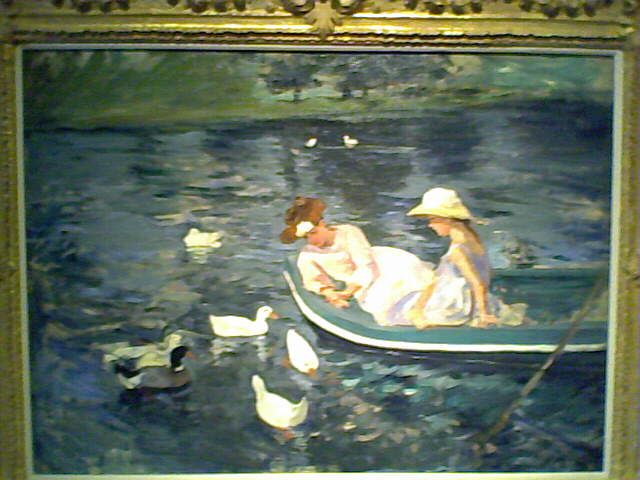
I am not an art critic so the various snapshots I took as experiments in cell phone photography are presented below without comment except for my brief descriptive captions.
![]() |
| A distinctly unusual family portrait |
![]() |
| An angry-looking child |
![]() |
| 10 Indians |
![]() |
| Boating women |
Subscribe to:
Posts (Atom)